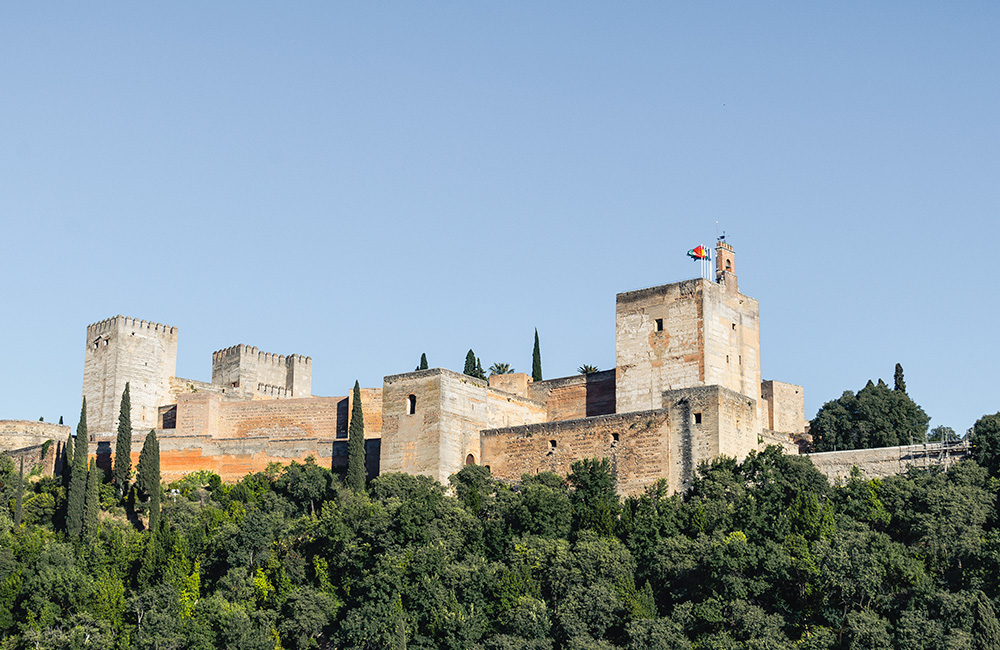
If you’re spending a few days in Granada, you’ll surely visit its most important landmark, the Alhambra. Broadly speaking, the Alhambra consists of a complex of palaces, gardens, and fortresses. Each structure holds fascinating stories, rich in culture and architecture. However, do you know all the parts of the Alhambra? If not, keep reading to learn much more about the most important parts of the Alhambra.
First, you should know that the Alhambra is divided into three main parts: the Nasrid Palaces, the Alcazaba, and the Generalife—though it also features other buildings of great historical and architectural significance, which we’ll discuss in depth below.
Alhambra: Main Parts
To help you delve deeper into the history of the Alhambra, we’ll walk you through all its parts.
The Nasrid Palaces
This is a palace complex consisting of three structures: the Mexuar, the Palace of Comares, and the Palace of the Lions. These three buildings were intended to serve as the personal residence of the Nasrid king and to handle the court’s administrative affairs. The Mexuar was used for audiences and important general assemblies where the sultan administered justice. Second, the Palace of Comares—also known as the Patio de los Arrayanes—formed part of the residence of the sultan and his family. Finally, the Palace of the Lions consisted of private quarters for the royal family.
The Palaces and Gardens of the Generalife
This area was set aside for the Muslim kings to rest and is notable for its carefully tended gardens, courtyards, and orchards. During the Nasrid period, these orchards and fruit gardens were part of the Alhambra’s food supply. Its oldest orchard is the Huerta Colorá, which remains unchanged to this day.
The Alcazaba
It is the oldest structure in the Alhambra, along with the Torres Bermejas. It is a fortress that protected the residence of the Muslim kings during the Islamic period. It functioned as a small city to serve the sultan and the royal family, as well as serving as a residence for their soldiers.
The Palace of Charles V
The Palace of Charles V was commissioned by Charles V, King of Spain and Elected Emperor of Germany. He made this decision following his visit to Seville after his wedding to Isabella of Portugal. The palace’s design initially called for two porticoed courtyards—one larger and one smaller—to the west and south, respectively; however, ultimately influenced by prominent figures of the time, he decided to build a palace in the Roman style.
The Courtyard of the Lions
The Court of the Lions is probably the part of the Alhambra you’ve heard the most about, since it’s the most visited and beloved section of the complex. It gets its name from the twelve lions surrounding the fountain in the center of the courtyard; a large dodecagonal basin rests atop these lions. This fountain, carved from white marble, is a magnificent example of Muslim culture.
The Medina
The word “medina” means “city” in Arabic. Consequently, this section was designed to resemble a small city, featuring the residences of the nobles and their servants, along with workshops, bakeries, public baths, and other buildings for administrative, religious, and even educational purposes.
El Partal
The Partal is considered one of the oldest structures in the Alhambra. It amazes visitors with its exquisite architectural composition, consisting of a large pool, a portico with five arches, and the Torre de las Damas (Ladies’ Tower), the latter being the palace’s main hall. Nearby, there are four small houses serving different functions. One of them stands out for its remarkable paintings, which are still preserved today.
La Rawda
In addition to their palaces, gardens, and fortifications, they built a mausoleum for their most important members. It is a symbol of the legitimacy of dynastic continuity, which is why they deemed it necessary to create a funerary pantheon, better known as La Rawda. Some time later, Boabdil, while in exile, took the remains of his ancestors with him to a rawda in the farmstead of Mondújar, which belonged to his wife.
Free Access to the Alhambra
You can enjoy some of these significant sites within the monumental complex free of charge. These parts of the Alhambra are: the Palace of Charles V, an area whose history we mentioned earlier; and the Plaza de los Aljibes, consisting of several cisterns that ensured the water supply—these were later covered over and transformed into a large esplanade between the Alhambra’s fortifications and the Puerta del Vino. This last monument can also be visited for free. This gate served an internal function; therefore, it provides direct access to the interior and is also the main entrance to the Alhambra’s Medina.
Interior of the Alhambra in Granada
As we’ve already mentioned, the Alhambra is made up of different sections, each built for a specific purpose, such as recreation, residence, or landscaping… It’s worth highlighting the most important parts of the Alhambra, such as the palaces that were commissioned on a whim or to add another room to the splendid Alhambra. Also worth mentioning are the Generalife Gardens, one of the most beautiful parts of the complex, renowned for their natural and cultural beauty. Finally, there’s the part we all know: the Court of the Lions, a place that hides more secrets than you can imagine.
Now that you know a little more about all the parts of the Alhambra, we recommend taking a guided tour of the Alhambra to soak up even more information. If you’d like to buy tickets for the Alhambra on our website, you’ll find various options available.
