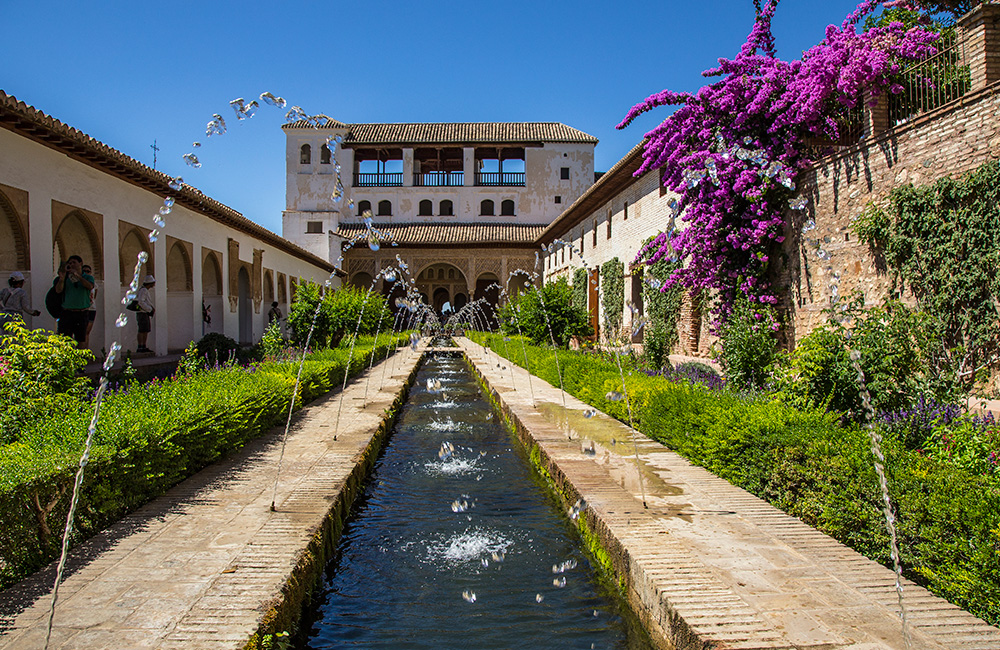
Have you ever wondered what the Generalife is? In this article, we’ll briefly explore the history and interesting facts about its gardens. Join us on this journey to discover the secrets that make this place a unique and fascinating destination for the many tourists who have visited it over the years.
What is the Generalife?
It is one of the most iconic and beautiful spots in the city of Granada, alongside the Alhambra, where you can visit the Patio de la Acequia, the Patio del Ciprés de la Sultana, and finally the Upper Gardens via the Escalera del Agua.
Did you know that the Generalife gardens, along with those of the Alhambra, are the oldest in Europe? To give you an idea of what Hispano-Muslim gardens were like, the Generalife in Granada is the only remaining example today.
Today, it remains a true symbol of Al-Andalus architecture and is one of the city’s most visited sites by crowds of tourists eager to discover what the Generalife is and learn more about it.
Please note that to access these gardens, you do not need to enter the Alhambra complex, as they are located outside its walls.
Generalife Gardens: History
Built between the 12th and 14th centuries, the Generalife is a palace located on Sabika Hill that was used as a country house and retreat by the Muslim kings. It is also surrounded by vegetable gardens and orchards that were used during the Nasrid period to supply the Alhambra.
In 1984, it was designated a World Heritage Site by UNESCO.
Lower Gardens
Built between 1931 and 1951, these gardens are modeled after Muslim gardens. Originally, this area served as a food supply zone for the entire palace and was later transformed into the current Lower Gardens, with the aim of visually unifying the Alhambra with the Generalife.
Upper Gardens
Landscaped in the 19th century in the style of the time; they are accessed via a steep flight of stairs leading from the Sultana’s Cypress Courtyard. From these gardens, visitors can enjoy beautiful panoramic views of the Alhambra.
In the Upper Gardens of the Generalife, one can observe the transition in landscape design from the Middle Ages to the Renaissance.
Patio de la Acequia
It dates back to the Nasrid period, although it has undergone various modifications over time and is one of the most iconic spaces in the Generalife.
Here you can find the Acequia Real, which was responsible for bringing water from a dam to the Generalife so it could later be distributed throughout the Alhambra.
Patio del Ciprés de la Sultana
Originally, this space was intended as the palace baths, so today practically nothing remains of them except for the water inlet from the canal.
In 1584, the porticoed building that houses the current Patio del Ciprés de la Sultana was erected, and the result of this transformation is a Baroque-style garden.
Why Are They Called the Generalife Gardens?
Now that you know what the Generalife is, where does its name come from? The origin of the name Generalife (in Arabic, Jannat al-‘Arif), although its etymology is uncertain, has been the subject of various interpretations. One theory suggests it comes from “The Architect’s Garden,” in a clear poetic-religious symbolism alluding to God, Allah, as the architect and creator of the universe; another theory states that it means “Garden of Paradise.”
How long does it take to see the Generalife Gardens?
The duration of a visit to the Generalife Gardens depends on the visitor’s interests and pace, but generally, it’s recommended to set aside at least 1.5 to 3 hours to explore and see the main areas.
Are you thinking of visiting the Generalife Gardens? Although they’re open every day and you can visit any day of the week, remember to plan your visit well in advance if you don’t want to miss out on tickets due to high demand.
It’s not enough just to know what the Generalife is. It’s a place you have to see to believe, so book your visit with us and immerse yourself in its history.
