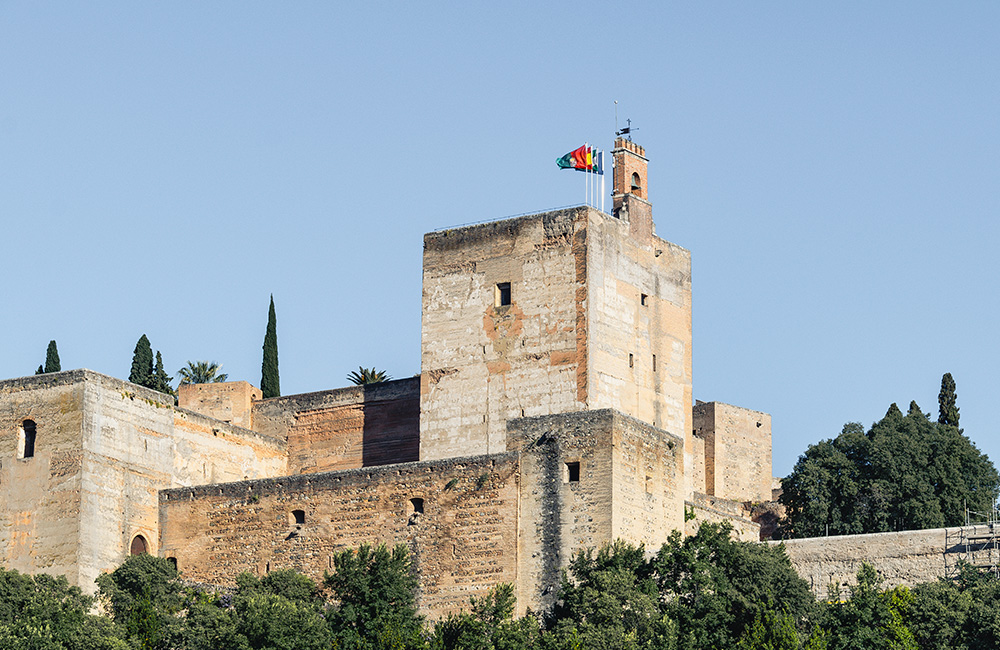
The Alcazaba of the Alhambra is one of Spain’s most important historical treasures. Located in the heart of Granada, this monument stands as a testament to Nasrid architecture and history.
What is the Alcazaba of the Alhambra?
The Alcazaba of the Alhambra is the oldest part of the Alhambra complex. It was built in the 13th century as a fortress designed to protect the sultan and his entourage. Located at the western end of the complex, the Alcazaba overlooks the city from the Red Hill, a strategic vantage point that provided security and control over Granada.
Unlike a typical castle, the Alcazaba includes a small medina within its walls, designed to house residences, plazas, and other essential services. Its main structure features defensive walls and imposing towers such as the Torre de la Vela, the Torre Quebrada, and the Torre del Homenaje. These towers not only served a defensive purpose but were also symbols of Nasrid power.
Interesting Facts About the Alcazaba of Granada
The history of the Alcazaba of the Alhambra is full of fascinating details that enrich its historical and cultural significance.
Origin and Evolution
Although the fortress reached its peak of splendor under the Nasrid dynasty, the original construction dates back to earlier times. As early as the 9th century, fortifications already existed on Red Hill, which were expanded and improved by the Nasrid rulers, particularly by Muhammad I, the first sultan of the Kingdom of Granada.
This leader transformed the Alcazaba into a self-sufficient complex by equipping it with advanced water supply systems using irrigation channels fed by the Darro River.
Life in the AlcazabaAlcazaba
The Alcazaba was not only a fortress but also a living space. The soldiers who defended the compound lived there, organized according to their rank and marital status. Unmarried soldiers resided in smaller dwellings to the left of the medina, while soldiers with families occupied larger houses to the right. All these houses surrounded a central courtyard, where daily life took place.
Beneath the Alcazaba were dungeons for enemy prisoners and rebels. Although these dungeons are closed to the public, they evoke the harsh living conditions within the darkness of their cells.
Baths and Iconic Towers
The Alcazaba baths, located beneath the Torre de la Vela, are the oldest in the complex. Built in 1240, they feature a simple and functional structure, although much of their original decoration and roofing has been lost.
The towers also play a prominent role. The Torre de la Vela—known in the Nasrid era as the Torre Mayor—and the Torre del Homenaje were symbols of the kingdom’s power and protection. The top floor of the Torre del Homenaje housed royal quarters, a testament to the life that took place there before the construction of the Nasrid Palaces.
Advanced Defensive System
The Alcazaba was the military heart of the Nasrid Kingdom, connected to an extensive defensive system that included fortresses, coastal watchtowers, and “rábitas,” which controlled both land and sea borders. Messages between these points were transmitted via smoke signals, mirrors, and fire, highlighting the ingenious military strategy of the era.
What Can You See at the Alcazaba of Granada?
The Alcazaba of the Alhambra is one of the monument’s highlights and offers visitors a unique experience.
Torre de la Vela
This tower, located at the far left of the Alcazaba, is one of the most iconic sites. From its summit, you can enjoy a panoramic view of Granada, including the Albaicín neighborhood and the Vega de Granada.
Plaza de Armas
Inside the Alcazaba lies the Plaza de Armas, where soldiers’ quarters and other communal spaces were once located. Today, you can see the remains of these buildings and get a sense of what life was like inside the fortress.
Defensive Walls and Towers
The imposing walls and towers, such as the Torre Quebrada and the Torre del Homenaje, bear witness to the Alcazaba’s strategic importance. Their sturdy construction was essential to ensuring the safety of the sultan and the city.
Views from the Mirador de San Nicolás
Although it is not part of the Alcazaba, the San Nicolás Viewpoint is one of the best places to admire the majesty of the Alhambra’s Alcazaba and the rest of the monumental complex.
If you’d like to learn more, you can explore our guided tours of the Alhambra—perfect for discovering the historical and cultural richness of this impressive monument.
Visiting the Alhambra is an unforgettable experience that combines art, history, and nature all in one place. Now that you know what to see at the Alhambra and how to plan your visit, you’ll leave with no corner unexplored. Be sure to set aside the time it deserves and experience one of Spain’s wonders to the fullest. And remember, with Alhambra Tickets Online, planning your visit will be simple and convenient, ensuring a hassle-free experience.
