
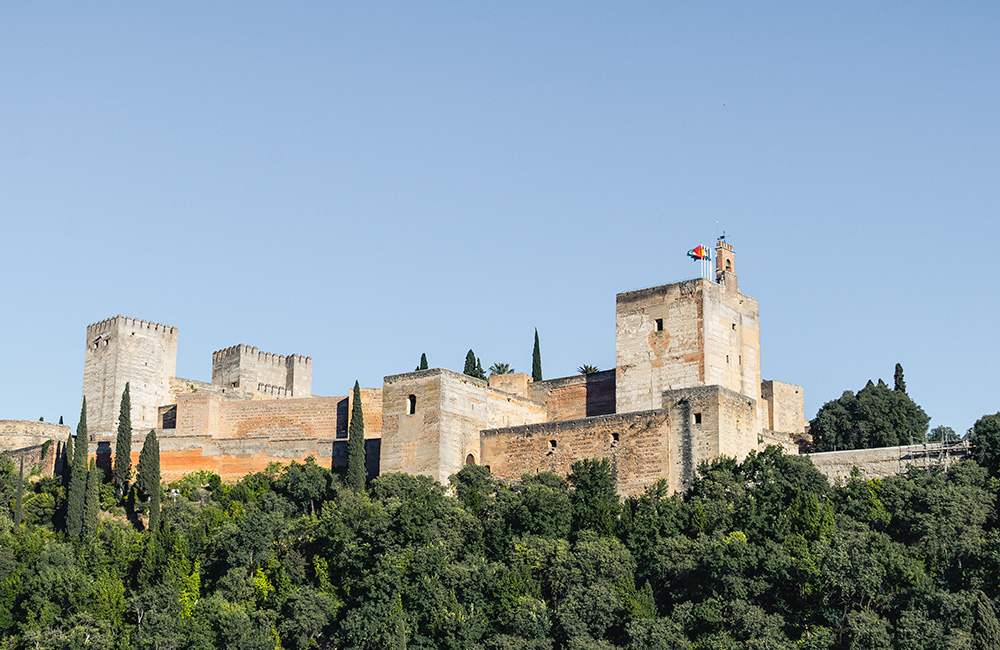
If you are spending a few days in Granada, you will surely visit its most important monument, the Alhambra. In general terms, the Alhambra consists of a complex of palaces, gardens and fortresses. Each structure has impressive stories to tell, steeped in culture and architecture. However, do you know all the different parts of the Alhambra? If not, keep reading to find out more about the most important parts of the Alhambra.
First, you should know that the Alhambra is divided into three main parts, which are the Nasrid Palaces, the Alcazaba and the Generalife, although it has other buildings of great historical and architectural importance, which we will discuss in depth below.
Alhambra: main parts
To help you delve deeper into the history of the Alhambra, we will tell you all about its different parts.
The Nasrid Palaces
It is a palatial complex consisting of three constructions: the Mexuar, the Palace of Comares, and the Palace of the Lions. The purpose of these three creations was to serve as the personal residence of the Nasrid king and for administrative matters of the court. The Mexuar was dedicated to audiences and important general meetings in which the sultan dispensed justice. Secondly, the Palace of Comares, also known as the Court of the Myrtles, formed part of the residence of the sultan and his family. Finally, the Palace of the Lions was made up of private quarters for the royal family.
The Palaces and Gardens of the Generalife
This space was dedicated to the rest of the Muslim kings, noted for its carefully tended gardens, courtyards, and orchards. In the Nasrid period, these orchards and fruit gardens formed part of the supplies available in the Alhambra. Its oldest orchard is the Huerta Colorá, which has remained unchanged to this day.
The Alcazaba
It is the oldest building in the Alhambra, together with the Torres Bermejas. It is a fortress that protected the residence of the Muslim kings during the Islamic period. A small city designed to serve the sultan and the royal family, as well as to house their soldiers.
The Palace of Charles V
The Palace of Charles V was commissioned by the King of Spain and Elected Emperor of Germany, Charles V. He made this decision after visiting Seville following his wedding to Isabella of Portugal. The architecture of this palace began with the idea of two porticoed squares, one larger and one smaller, to the west and south respectively, but ultimately, influenced by important figures of the time, he decided to build a palace in the Roman style.
The Court of the Lions
The Patio de los Leones is probably the part of the Alhambra you have heard most about, as it is the most popular and beloved part of the complex. Its name comes from the twelve lions surrounding the fountain in the centre of the courtyard, on top of which stands a large dodecagonal vessel. This fountain, carved in white marble, is a fine example of Muslim culture.
The Medina
The word "medina" means “city” in Arabic. Therefore, this area resembled a small city that contained the homes of the nobles and their servants, along with workshops, ovens, public baths, and several other buildings for administrative, religious, and even educational purposes.
The Partal
El Partal is considered one of the oldest buildings in the Alhambra. It amazes visitors with its exquisite architectural composition, consisting of a large pool, a portico with five arches and the Torre de las Damas (Tower of the Ladies), the latter being the main room of the palace. In addition, there are four small houses nearby with different functions. One of them stands out for its amazing paintings, which are still preserved today.
The Rawda
In addition to its palatial buildings, gardens, and fortifications, they built a mausoleum for the most important members. It is a symbol of legitimacy and dynastic continuity, which is why they deemed it necessary to create a funerary pantheon, mostly known as La Rawda. Some time later, Boabdil, during his exile, took with him the remains of his ancestors to a rawda in the hamlet of Mondújar, his wife’s property.
Free part of the Alhambra
You can enjoy some of these significant places within the monumental complex free of charge. These parts of the Alhambra are: the Palace of Charles V, an area whose history we have previously mentioned; the Plaza de los Aljibes, made up of several cisterns that ensured the water supply, which were later covered and turned into a large esplanade between the fortifications of the Alhambra and the Wine Gate. This latter monument can also be visited free of charge. This gate served an internal function, which is why its access leads directly inside; it is also the main entrance to the Medina of the Alhambra.
Alhambra of Granada interior
As we have already mentioned, the Alhambra is made up of different parts, each built for different purposes, such as leisure, residence, or gardening. It is worth highlighting the most important areas of the Alhambra, such as the palaces commissioned either out of whim or to add another room to the splendid Alhambra. On the other hand, the Gardens of the Generalife stand out as one of the most beautiful parts of the site, for their natural and cultural charm. Finally, there is the part we all know, the Court of the Lions, a place that hides more secrets than you might imagine.
Now that you know a little more about all the parts of the Alhambra, we recommend that you take a guided tour of the Alhambra and soak up much more information. If you wish to purchase tickets for the Alhambra, you can find different options on our website.