
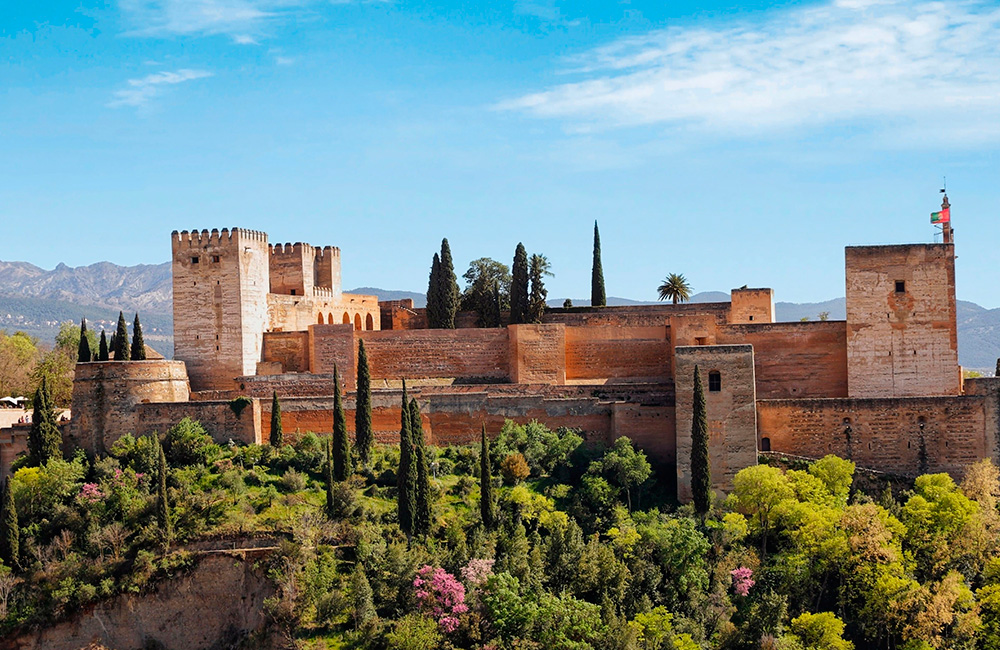
Do you know the history of the Alhambra? The Alhambra in Granada is one of the most representative monuments of Spain and a living legacy of the rich cultural history of Andalusia.
The Alhambra, located in La Sabika Hill, has captivated visitors from all over the world for its architectural beauty, fascinating history and connection with the historical evolution of the Iberian Peninsula. In this article, we explore in depth the history of the Alhambra, its origins, the stages of its development and the curiosities that make the Alhambra a unique place.
What is the Alhambra?
The Alhambra is a walled palatine city which combines elements of military fortress, royal residence and ceremonial space.
Its name, derived from Arabic Al-Hamra (the red one), refers to the reddish color of its walls and towers, especially visible at sunset. It is an architectural complex that, in addition to the Nasrid Palaces, includes the Alcazaba, the Generalife, the Palace of Charles V, gardens, and remains of the old medina.
The location of the Alhambra is not a coincidencebuilt on La Sabika Hill, it dominates the city of Granada and offers privileged views of the Darro River Valley, the Vega de Granada and the Albaicín district. Its strategic position made it a defensive bastion and a symbol of power for the Nasrid dynasty, la last of the Islamic dynasties in the Iberian Peninsula.
History of the Alhambra
The history of the Alhambra dates back to the 9th century, when a small fortification was built on La Sabika Hill. However, its transformation into the complex we know today began in the 13th century, with the arrival of the Nasrid dynasty. Over the centuries, the Alhambra has witnessed numerous historical events, from its splendor as a royal residence to its reconquest and subsequent abandonment.
History of the Alhambra in brief
The early years: 9th century
The first historical record of the Alhambra dates back to the 9th century, when Sawwar ben Hamdun, a Muslim leader, built a small fortress to protect himself during the internal conflicts within the Emirate of Córdoba. This initial structure, rudimentary and functional, lacked the monumental character that would later define the Alhambra.
The Nasrid Alhambra: 13th to 15th centuries
The true transformation of the AlhambraIt began in 1238, when Muhammed I (Al-Ahmar), founder of the Nasrid dynasty, established Granada as the capital of his kingdom and decided to make La Sabika Hill the center of his power. From then on, the Nasrid monarchs carried out a extensive construction program which spanned more than two centuries.
In addition, Muhammed I reinforced the existing walls and built the Alcazaba, which became the defensive core of the complex and established an advanced hydraulic system to supply water to the Alhambra, using the Royal Canal, which diverted water from the Darro River.
During the reigns of Yusuf I (1333-1354) and Muhammad V (1354-1391), the Alhambra reached its architectural and artistic heyday.Yusuf I built the Comares Room, including the majestic Hall of Ambassadors, used as a courtroom.
Muhammed V added the emblematic Hall of Lions, known for its central fountain surrounded by lion sculptures, a perfect example of Nasrid sophistication.
In 1492, the Alhambra was handed over to the Catholic Monarchs after the capitulation of Granada, marking the end of Islamic domination on the Iberian Peninsula. This event not only marked a change in power, but also a transformation in the complex's use and symbolism.
The Christian Alhambra: 16th to 19th centuries
After the Christian conquest, the Alhambra underwent significant changes, both architectural and functional.
In 1526, the Emperor Charles V He ordered the construction of a Renaissance palace within the Nasrid enclosure, a project that symbolized Christian victory. Although its classical design contrasts with Islamic architecture, the Palace of Charles V It is today one of the most outstanding pieces of the complex.
Throughout the 17th and 18th centuries, the Alhambra was abandoned and suffered significant damage, including looting and partial destruction. During the Napoleonic occupation In the 19th century, several parts of the complex were deliberately destroyed.
Renaissance and Restoration: 19th Century onwards
The history of the Alhambra includes its rediscovery during the Romantic movement of the 19th century. Writers and artists, such as Washington Irving, whose work Tales of the Alhambra popularized the monument, helping to spark international interest in its preservation.
In 1870, the Alhambra was declared National monument and began a long restoration process, which continues to this day.
Architecture and art of the Alhambra
The Alhambra is an extraordinary example of the Islamic architecture, characterized by its attention to detail, the use of geometry and the integration of decorative elements with the natural environment. The main features are:
- Geometric and calligraphic decoration: The walls are covered with intricate geometric designs, arabesques, and Arabic texts praising Allah.
- Water use: Fountains, ponds and irrigation ditches not only have a decorative function, but also a symbolic one, representing purity and abundance.
- Symmetry and light: The interior spaces are designed to take advantage of natural light, creating an atmosphere of serenity.
Curiosities of the Alhambra: Secrets and fascinating anecdotes
The Alhambra is a place full of mysteries and details that make it unique. Over the centuries, this monumental complex has inspired legends and theories:
- A poem on each wall:The walls of the Alhambra are decorated with more than 10,000 Arabic inscriptions, ranging from verses from the Quran to poems and praises of the Nasrid monarchs. Many of these inscriptions are the work of the poet Ibn Zamrak, who worked directly for the Nasrid court.
- The acoustic effect of the Hall of the Abencerrajes:This space is known not only for its architectural beauty, but also for its incredible acoustics. If you whisper in one corner of the room, the sound can be clearly heard from the other.
How to visit the Alhambra: A practical guide
If you wonder How to plan your visit to the AlhambraHere you have all the information you need to make the most of this experience.
Buying tickets online
The most practical way to Getting tickets to the Alhambra is done through the Internet.. Booking online allows you secure your entry, especially during peak seasons or holidays, when demand is high.
- Access our website:
You can buy your tickets on our platform Alhambra Tickets Online, where you'll find all the available options: guided tours, private tours, night tours, and more. - Select the entry type:
There are several options:- Complete Guided Tour of the Alhambra: Includes a visit to the Alcazaba, Nasrid Palaces and Generalife.
- Night visits: Available for the Nasrid Palaces throughout the year and for the Generalife in specific months (March to June and September to October).
- Private tour: It gives travelers the opportunity to see the Alhambra in a personalized way based on what they are most interested in seeing.
- Audio-guided tour of the Nasrid Palaces, Generalife and the Alcazaba: Discover the entire Alhambra equipped with an audio guide.
- Guided tour of the gardens: Includes Alcazaba and Generalife, but not the Nasrid Palaces.
- Choose date and time
- Make the payment:
Visa and Mastercard are accepted. Once payment is complete, you will receive your tickets by email with a confirmation e-mail. QR code. - Bring your tickets on the day of the visit:
You can submit them digitally or print them at home. You will also need your identity document or passport to access.
In conclusion, the Alhambra in Granada is not just a monument; it is a testimony of history, culture and the coexistence of civilizations In Spain. To learn about the history of the Alhambra is to delve into the heart of Granada's history and discover a legacy that lives on in every corner of its palaces and gardens.