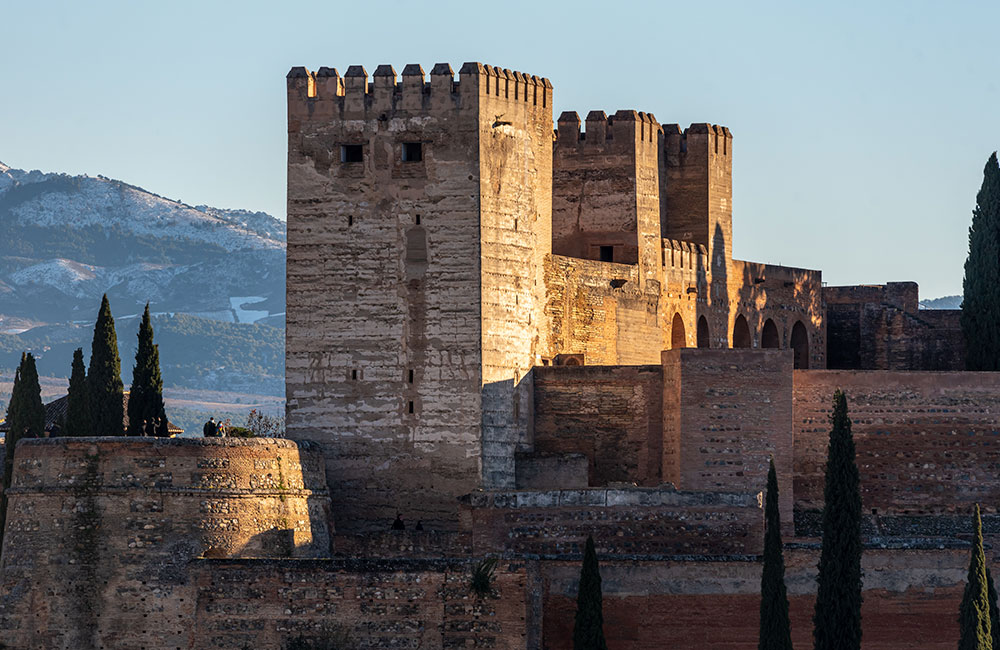
The Alhambra in Granada is not just a complex of monuments; it is a living testament to an era when Andalusian culture reached one of its greatest heights. Its palaces, courtyards, and gardens have inspired poets, travelers, and artists for centuries. However, one question continues to pique the curiosity of visitors: Who built the Alhambra, and how did this architectural marvel come to be?
To answer this question, we must go back in time and trace a history that combines military strategy, artistic refinement, and the power of a dynasty that forever shaped Granada’s identity.
Sabika Hill Before the Alhambra
The site where the Alhambra stands today—Sabika Hill—was occupied long before its famous palaces were built. During the 11th century, the Zirid dynasty constructed a defensive fortress to protect the city of Granada, which had recently been established as the kingdom’s capital. However, those walls were more austere and lacked the splendor we associate with the monument today.
It was with the arrival of the 13th century—amid political instability and border wars—that the hill became the perfect setting to erect a fortress-palace capable of withstanding attacks while simultaneously showcasing the power of its ruler.
Who Built the Alhambra: The Legacy of Muhammad I ibn Nas
The true founder of the Alhambra was Muhammad I ibn Nasr, also known as Al-Ahmar (“the Red”), the first sultan of the Nasrid dynasty. In 1238, after consolidating his power in Granada, he decided to establish his court on the Sabika Hill. There he ordered the construction of a fortress with walls, towers, and a citadel, laying the foundation for the future palace complex.
Muhammad I envisioned the Alhambra not merely as a military structure, but as a palatial city that would house not only his family and personal guard, but also the kingdom’s administration. His choice of location was no accident, as the hill provided a vantage point from which to visually control the city and the Vega de Granada, ensuring security and strategic control.
Nasrid Splendor: Yusuf I and Muhammad V
Although Muhammad I was the founder, the true embellishment of the Alhambra came with his descendants. Among them, Yusuf I (1333–1354) and Muhammad V (1354–1391) stand out, considered the great patrons of the Nasrid Alhambra.
During their reigns, some of the most iconic spaces were built and decorated:
- The Comares Palace, the sultan’s official residence and a symbol of his power.
- The Courtyard of the Lions, a masterpiece of Nasrid art, with its central fountain supported by twelve lion sculptures.
- The Hall of the Abencerrajes and the Hall of the Two Sisters, which stand out for their intricate muqarnas vaults and poetic inscriptions.
These rulers transformed the Alhambra into a place that combined a defensive function with unprecedented aesthetic refinement, making it the political and cultural heart of the Nasrid kingdom.
From Islamic Fortress to Christian Palace
In 1492, with the conquest of Granada by the Catholic Monarchs, the Alhambra passed into the hands of the Castilian monarchy. Although they preserved much of the Nasrid structure, they incorporated new elements, such as the Church of Santa María de la Alhambra and the royal apartments.
Later, Emperor Charles V ordered the construction of an imposing Renaissance palace within its walls; although this broke with the Islamic aesthetic, it added a new chapter to its architectural history.
Over the centuries, the monument suffered periods of neglect and deterioration, but beginning in the 19th century—thanks to the interest of Romantic travelers such as Washington Irving—its restoration and conservation began, eventually transforming it into the symbol we know today.
If you’ve ever wondered who built the Alhambra, you now know that it was born from the vision of Muhammad I ibn Nasr, but its splendor is owed to generations of artisans, architects, and rulers who knew how to create a unique space where military fortification and artistic refinement converge.
Today, walking through its courtyards and halls is like traveling back to a time when Granada was the last Muslim kingdom on the Iberian Peninsula. To fully enjoy this experience, there’s nothing better than using an audio guide to the Alhambra and
Ultimately, understanding what the Alhambra is and who built it means understanding not only the history of a monument, but also the memory of a people who left behind an artistic legacy of incalculable value.
