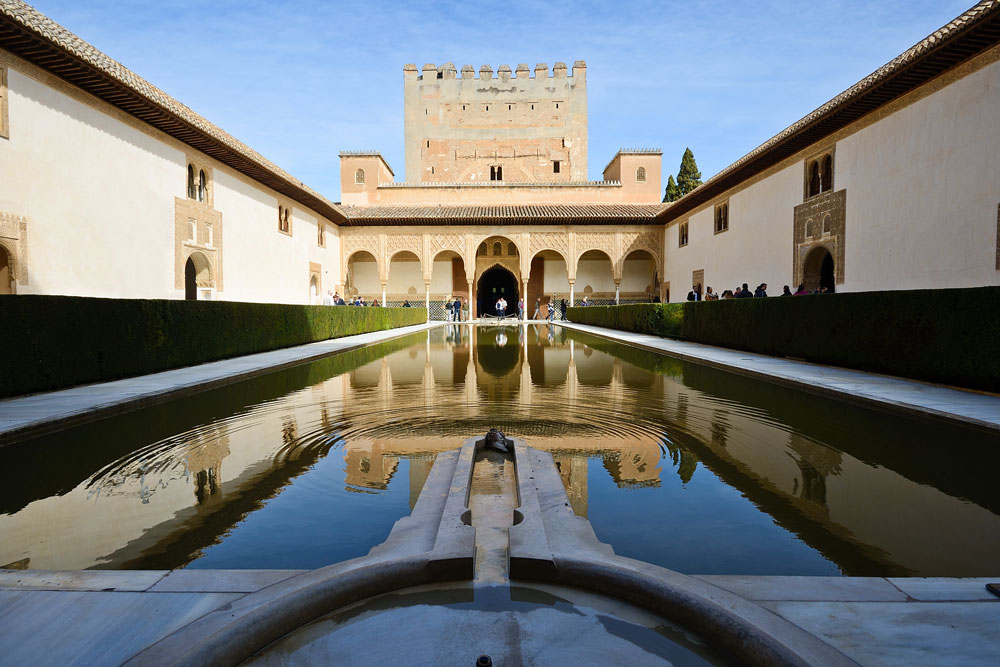
The Patio de los Arrayanes is one of the most elegant and serene spaces in the Alhambra. Its large central pond, flanked by perfectly trimmed myrtle hedges, creates an iconic scene where the architecture is reflected in the water with almost hypnotic precision. This courtyard stands out not only for its beauty but also for the symbolic role it played within the Nasrid palace complex.
Patio de Comares or Patio de los Arrayanes
The Patio de los Arrayanes is also known as the Patio de Comares or Patio de los Arrayanes, as it forms part of the Comares Palace, the sultan’s official residence. This dual name reflects both its location and its most distinctive botanical feature.
During the Nasrid period, this courtyard served as a prelude to power, regulating access to the palace’s most important rooms. Its sober and balanced design conveyed a sense of order, calm, and authority.
History
The Patio de los Arrayanes played a central role in the political and ceremonial life of the Alhambra during the Nasrid period. Its construction took place during a time of great splendor for the Kingdom of Granada, when the sultans established the palace complex as the seat of power and a symbol of authority.
This courtyard was not a space for everyday use, but rather a ceremonial area that organized access to the palace’s most important rooms, especially the Hall of Ambassadors. Its purpose
Over the centuries, the Patio de los Arrayanes has witnessed political and cultural changes, from the fall of the Nasrid kingdom to its integration into Christian Granada. Despite this, it has retained its essential structure, allowing us today to understand how palace space was conceived at the Alhambra.
This historical context helps us understand that the courtyard is not merely a decorative element, but a key component within the architectural and symbolic narrative of the monumental complex.
Why Is It Called the Patio de los Arrayanes?
The name Patio de los Arrayanes comes from the myrtle hedges that run lengthwise along the central pond. This plant, with its small, deep-green leaves, was highly prized in Islamic architecture for its durability, its fragrance, and its ability to create clean, symmetrical lines.
Beyond its decorative function, the myrtle symbolizes permanence and harmony—values deeply embedded in Nasrid art. Its arrangement reinforces the courtyard’s geometry and guides the eye toward the far end, where the façade of the Comares Palace rises, reflected in the water.
Where is the Patio de los Arrayanes?
For those wondering where the Patio de los Arrayanes is located, it is inside the Nasrid Palaces, specifically in the Comares Palace. It is one of the first areas visitors pass through upon entering this section of the monumental complex.
From the courtyard, you enter the Hall of Ambassadors, the largest and most solemn room in the Alhambra, where the sultan received dignitaries and held official ceremonies. This connection underscores the courtyard’s importance as the palace’s central hub.
The Patio de los Arrayanes at the Alhambra in Granada
At the Alhambra in Granada, the Patio de los Arrayanes stands out for its balance between architecture and nature. The central pond acts as a mirror, visually duplicating the palace’s façade and creating a sense of depth and calm.
The absence of superfluous elements reinforces the purity of the ensemble. Here, the focus is on water, light, and proportion—essential elements of Islamic art. The gentle sound of the water and the reflection that changes with the time of day make this space one of the most contemplative in the complex.
Patio de los Arrayanes: Interesting Facts
Among the interesting features of the Patio de los Arrayanes, the role of the pond as a climate-regulating element stands out: it helped cool the air and regulate the temperature in the nearby rooms. Furthermore, its design is intended to be viewed from different vantage points, especially from the Hall of Ambassadors.
Another interesting fact is that, unlike other more ornate courtyards, this one features a restrained aesthetic. This simplicity is no accident, as the intention was to convey solemnity and reinforce the sultan’s image of power.
Also striking is the precision with which the myrtle hedges are maintained—a constant effort that preserves the courtyard’s original appearance and allows visitors to appreciate its symmetry exactly as it was conceived centuries ago.
Tips for Your Visit
To fully enjoy this courtyard, it’s best to pause for a few minutes and observe how the palace’s reflection changes with the light. The early morning and late afternoon offer particularly favorable lighting.
Since it is part of the Nasrid Palaces, it is important to remember that access is subject to specific hours posted at the entrance. Planning your visit in advance will allow you to enjoy the courtyard at your own pace and appreciate its details without rushing.
The Patio de los Arrayanes is one of the purest expressions of Nasrid art in the Alhambra. Its balance, symbolism, and relationship with the Comares Palace make it a key space for understanding the palatial architecture of the Kingdom of Granada. Beyond its photogenic beauty, it is a place designed for contemplation, where water and light tell the story of centuries of history.
